
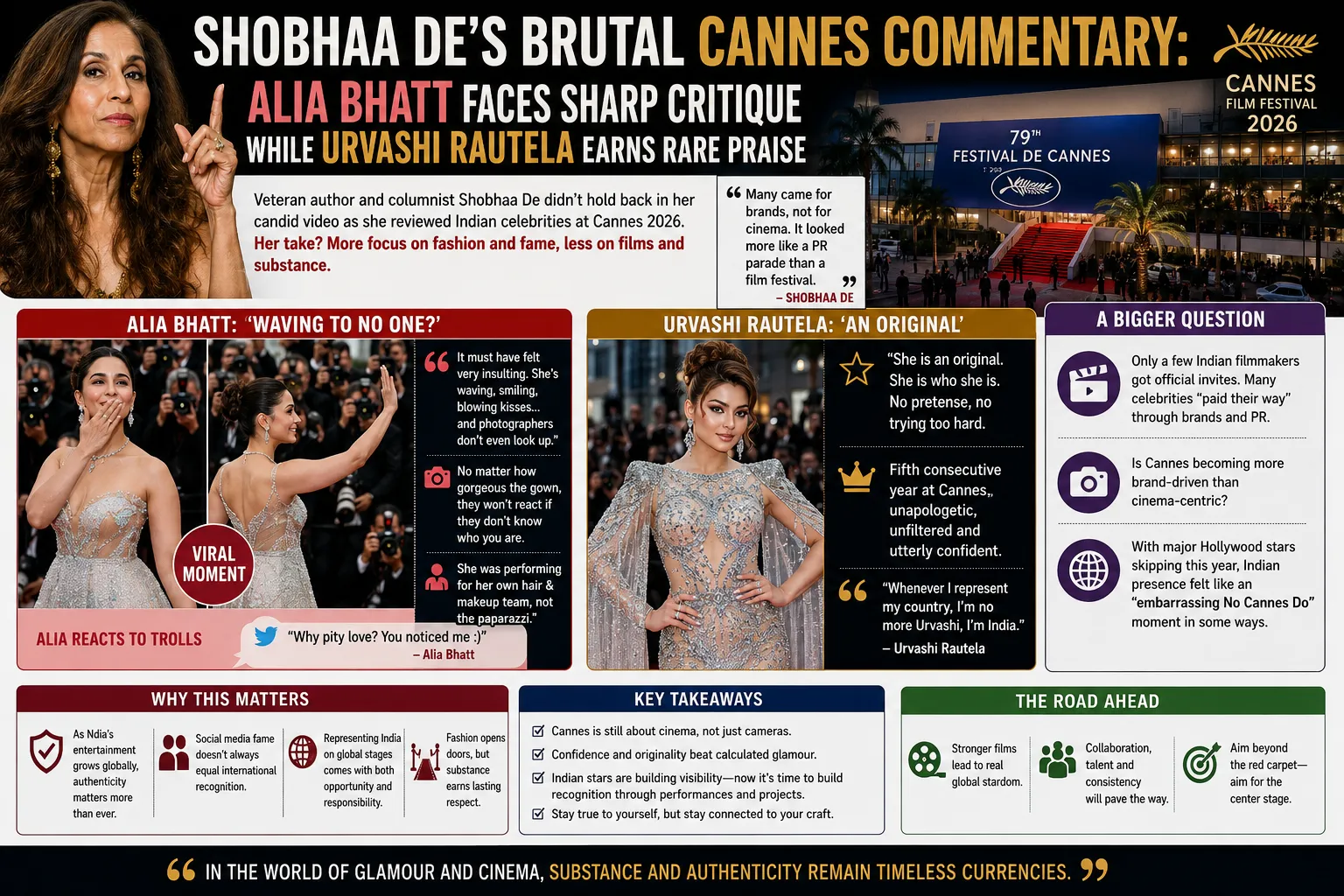
The 79th Cannes Film Festival in 2026 once again drew global attention for its blend of cinema, glamour, and high fashion. While international stars and filmmakers showcased substantive work, the growing presence of Indian celebrities on the red carpet sparked intense scrutiny back home. Veteran author and social commentator Shobhaa De delivered one of the most unfiltered assessments in a candid video, dissecting the appearances of Indian stars with her signature bluntness. Her remarks, which particularly targeted Alia Bhatt while offering unexpected appreciation for Urvashi Rautela, have intensified debates about the evolving purpose of celebrity attendance at prestigious festivals like Cannes.
Shobhaa De, known for her sharp observations on celebrity culture and society, did not mince words. She suggested that many Indian attendees seemed more focused on brand partnerships, designer couture, and social media optics than on genuine cinematic engagement. According to De, the red carpet moments often projected desperation rather than effortless elegance or star power. Her commentary highlighted a perceived gap between self-perception and international recognition, turning the spotlight on authenticity versus performance.
Alia Bhatt’s Viral Moment Under the Scanner
Alia Bhatt, one of Bollywood’s most prominent contemporary stars and a global brand ambassador for L’Oréal Paris, made multiple appearances at Cannes 2026. She debuted looks including a hand-painted pastel gown and a custom sari-inspired ensemble that received praise from fashion publications. However, a particular red carpet video went viral for all the wrong reasons. In the clip, Alia is seen smiling, waving enthusiastically, and blowing kisses, only for many international photographers to appear unresponsive or to lower their cameras.
Shobhaa De zeroed in on this moment with biting humor. She remarked that it must have felt “very insulting” for the actress, noting that Alia appeared to be waving and performing for her own hair and makeup team rather than a throng of paparazzi. De suggested that no matter how stunning the couture, global photographers will not react if they do not recognize the personality behind the gown. Her critique implied that fame confined largely to Indian audiences does not automatically translate into international star power.
This observation struck a nerve. While Alia has delivered critically acclaimed performances in films like Raazi and Gangubai Kathiawadi, and commands a massive following at home, De’s commentary underscored the challenges Bollywood faces in achieving universal recognition. Alia responded to online trolls with characteristic wit, replying to a pity comment with “Why pity love? You noticed me :)”, earning admiration for her grace under pressure. Yet De’s remarks amplified discussions about the difference between curated social media success and organic global presence.
The Surprising Praise for Urvashi Rautela
In a surprising twist, Shobhaa De reserved her warmest words for Urvashi Rautela. The actress, attending Cannes for the fifth consecutive year, walked the red carpet in a custom crystal-encrusted gown by Vietnamese label JoliPoli, complete with dramatic cape sleeves. Known for her maximalist style and unapologetic persona, Urvashi made headlines by declaring, “Whenever I represent my country, I’m no more Urvashi, I’m India.”
De appeared charmed by this theatrical confidence. She described Urvashi as “an original” and someone who is “who she is,” without pretense. Unlike others who, according to De, tried too hard to project sophistication, Urvashi’s larger-than-life approach felt authentic to her public image. This rare approval stood in stark contrast to the critique aimed at other celebrities and highlighted De’s preference for unfiltered individuality over calculated glamour.
Urvashi’s consistent Cannes appearances, complete with Namaste greetings to fans and media, have carved a unique niche for her as a dedicated red carpet regular. While critics often dismiss her style as over-the-top, De’s commentary suggested that such consistency and self-assurance deserve recognition in a space increasingly dominated by manufactured moments.
Broader Critique: Fashion Over Substance?
Beyond individual assessments, Shobhaa De’s video raised a larger question: Has the Cannes Film Festival become more brand-driven than cinema-centric? She pointed out that only a handful of Indian filmmakers received official invitations, while many celebrities appeared to have “paid their way” through brand associations and PR exercises. With several major Hollywood figures skipping the 2026 edition, De described the Indian presence as an “embarrassing No Cannes Do moment” in some respects.
Her commentary resonates with ongoing discussions about celebrity culture in the digital age. Red carpets today serve as powerful marketing platforms where fashion houses, beauty brands, and luxury labels compete for visibility. For Indian stars, these appearances offer opportunities to expand their global footprint and secure international endorsements. However, critics like De argue that without substantial cinematic contributions or genuine recognition, such visits risk appearing performative.
This debate reflects deeper shifts in the entertainment industry. Social media has democratized fame but also blurred lines between actors, influencers, and brand ambassadors. Festivals like Cannes, historically celebrations of auteur cinema, now navigate a hybrid ecosystem where glamour generates buzz and revenue. The tension between artistic credibility and commercial ambition becomes particularly visible when Bollywood stars step onto the international stage.
The Cultural and Industry Implications
Shobhaa De’s blunt take has sparked polarized reactions. Supporters praise her for calling out perceived inauthenticity and urging greater substance in international forays. Detractors argue that her commentary is overly harsh, ignoring the barriers Indian celebrities face in gaining Western recognition and the positive representation they provide.
Alia Bhatt’s graceful handling of criticism demonstrates the resilience many modern stars cultivate. Her Cannes appearances, regardless of paparazzi response, still generated significant Indian media coverage and brand value. Similarly, Urvashi Rautela’s bold approach continues to build a distinct personal brand that appeals to a specific audience segment.
The episode also highlights evolving expectations around celebrity diplomacy and soft power. As India’s entertainment industry grows in global influence, the manner in which its stars present themselves on world stages carries cultural weight. Authenticity, confidence, and a clear sense of purpose may ultimately matter more than fleeting red carpet validation.
Lessons from the Red Carpet Roasting
Shobhaa De’s commentary serves as a mirror to the Indian entertainment fraternity. It encourages reflection on why celebrities attend Cannes — whether for artistic validation, career expansion, personal branding, or simply the experience. Her preference for Urvashi’s originality over more polished but less impactful efforts suggests that embracing one’s unique identity might resonate stronger than attempting to fit into unfamiliar molds.
In an era where every appearance is dissected instantly across platforms, public figures face unprecedented pressure. Yet, as De implies, true presence comes from within — a combination of talent, self-assurance, and substance that transcends borders.
As the curtains close on Cannes 2026, Shobhaa De’s unapologetic voice adds a compelling layer to the annual festival discourse. Her remarks may sting in the moment, but they contribute to a necessary conversation about representation, recognition, and the future of Indian stardom on the global stage. Whether one agrees with her assessments or not, the debate she ignited underscores that in the world of glamour and cinema, substance and authenticity remain timeless currencies.
pressnbcnews pressnbcnews pressnbcnews pressnbcnews pressnbcnews pressnbcnews pressnbcnews pressnbcnews pressnbcnews pressnbcnews pressnbcnews pressnbcnews pressnbcnews pressnbcnews pressnbcnews pressnbcnews pressnbcnews pressnbcnews pressnbcnews pressnbcnews pressnbcnews pressnbcnews pressnbcnews pressnbcnews pressnbcnews pressnbcnews pressnbcnews pressnbcnews pressnbcnews pressnbcnews pressnbcnews pressnbcnews pressnbcnews pressnbcnews pressnbcnews pressnbcnews pressnbcnews pressnbcnews pressnbcnews pressnbcnews pressnbcnews pressnbcnews pressnbcnews pressnbcnews pressnbcnews pressnbcnews pressnbcnews pressnbcnews pressnbcnews pressnbcnews pressnbcnews pressnbcnews pressnbcnews pressnbcnews pressnbcnews pressnbcnews pressnbcnews pressnbcnews pressnbcnews pressnbcnews pressnbcnews pressnbcnews pressnbcnews pressnbcnews pressnbcnews pressnbcnews pressnbcnews pressnbcnews pressnbcnews pressnbcnews pressnbcnews pressnbcnews pressnbcnews pressnbcnews pressnbcnews pressnbcnews pressnbcnews pressnbcnews pressnbcnews pressnbcnews pressnbcnews pressnbcnews pressnbcnews pressnbcnews pressnbcnews pressnbcnews pressnbcnews pressnbcnews pressnbcnews pressnbcnews pressnbcnews pressnbcnews pressnbcnews pressnbcnews pressnbcnews pressnbcnews pressnbcnews pressnbcnews pressnbcnews pressnbcnews pressnbcnews pressnbcnews pressnbcnews pressnbcnews pressnbcnews pressnbcnews pressnbcnews pressnbcnews pressnbcnews pressnbcnews pressnbcnews pressnbcnews pressnbcnews pressnbcnews pressnbcnews pressnbcnews pressnbcnews pressnbcnews pressnbcnews pressnbcnews pressnbcnews pressnbcnews pressnbcnews pressnbcnews pressnbcnews pressnbcnews pressnbcnews pressnbcnews pressnbcnews pressnbcnews pressnbcnews pressnbcnews pressnbcnews pressnbcnews pressnbcnews pressnbcnews pressnbcnews pressnbcnews pressnbcnews pressnbcnews pressnbcnews pressnbcnews pressnbcnews pressnbcnews pressnbcnews pressnbcnews pressnbcnews pressnbcnews pressnbcnews pressnbcnews pressnbcnews pressnbcnews pressnbcnews pressnbcnews pressnbcnews pressnbcnews pressnbcnews pressnbcnews pressnbcnews pressnbcnews pressnbcnews pressnbcnews pressnbcnews pressnbcnews pressnbcnews pressnbcnews pressnbcnews